
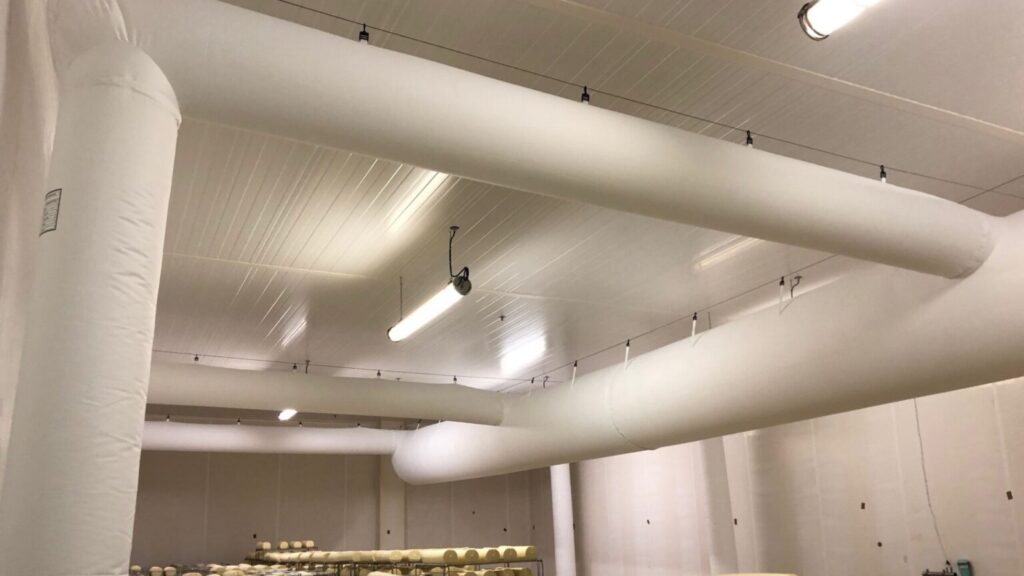
What happens inside a textile duct when it isn’t cleaned?
In many ventilation systems, textile ducts play a key role: distributing air evenly within a space. However, when they are not properly maintained, their internal condition gradually changes, affecting both air quality and system performance.
Although they may appear to be in good condition on the outside, what happens inside the duct is very different. Below, we explain what technically occurs when a textile duct is not cleaned.
1. Progressive accumulation of particles
From the very first day of operation, the duct begins to capture particles present in the air such as:
- Environmental dust
- Fibers
- Residues from the production process
- Suspended particles
These particles adhere to the internal textile surface due to the constant airflow and the nature of the material itself.
What does this imply?
A buildup layer is formed over time, reducing system efficiency and becoming a source of contamination.
2. Saturation of the textile fiber
Textile ducts are designed to allow controlled air distribution. However, when the fibers become saturated:
- The pores of the material become partially blocked
- The way air is distributed is altered
- Ventilation uniformity is lost
Result:
The system begins to operate irregularly, with areas receiving more or less airflow than required.
3. Proliferation of microorganisms
The combination of dust + humidity + temperature creates an ideal environment for the development of:
- Bacteria
- Fungi
- Microorganisms
These can lodge within the duct structure and later be dispersed into the environment.
Impact:
- Reduced air quality
- Health risks for personnel
- Potential issues in sensitive processes (such as food or pharmaceutical production)
4. Alteration of airflow
When the interior of the duct is contaminated or saturated:
- Air encounters greater resistance
- Pressure variations occur
- The system requires more effort to operate
Direct consequence:
Lower operational efficiency and higher energy consumption.
5. Deterioration of the textile structure
If contaminants are not removed in time, they can begin to directly affect the fibers:
- Accumulation of chemical residues or vapors
- Material degradation
- Loss of functional properties
Result:
The duct may lose performance and even require premature replacement.
6. Risks in compliance and audits
A textile duct without maintenance can become a point of concern during audits, as it:
- Represents a potential source of contamination
- Shows lack of environmental control
- May affect hygiene standards
Although a textile duct may look clean on the outside, multiple processes may be occurring inside that directly affect air quality, system efficiency, and operational safety.
The good news is that, unlike other systems, textile ducts allow for more accessible, efficient, and controlled maintenance, making it easier to keep them in optimal condition without major complications.
At HAS México, we specialize in the cleaning, disinfection, and maintenance of textile ducts, helping keep your system running properly and your air under control.